History and Design Concept of Howrah Bridge
Introduction
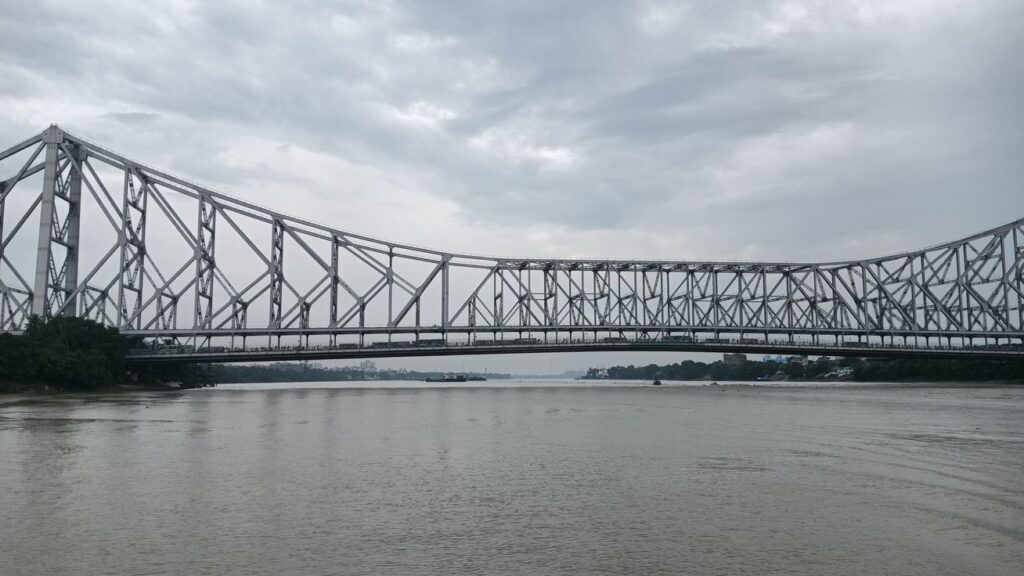
The Howrah Bridge is one of the most famous and busiest bridges in India. It spans the Hooghly River and connects the city of Kolkata with Howrah in West Bengal. The bridge is an important transportation link and carries millions of pedestrians and vehicles every day.
Completed in 1943, the bridge is considered a remarkable example of steel engineering and cantilever bridge design. In 1965, the bridge was renamed Rabindra Setu in honor of the Nobel Prize–winning poet Rabindranath Tagore.
Historical Background
Early Transportation Across the Hooghly River
Before the construction of the present bridge, transportation between Kolkata and Howrah relied on ferries. Due to the rapid growth of trade and population during British rule, the need for a permanent bridge became essential.
In 1874, the British Government constructed a floating pontoon bridge across the Hooghly River. However, increasing traffic soon made it insufficient to handle the growing demand.
Construction of the New Bridge
To solve this problem, authorities planned a stronger and more permanent structure.
Construction of the modern Howrah Bridge began in 1936 and was completed in 1943 during World War II. Despite wartime challenges, engineers successfully completed one of the largest cantilever bridges of its time.
The bridge required approximately 26,500 tons of high-tensile steel, most of which was supplied by Tata Steel. Interestingly, the bridge was assembled using rivets instead of nuts and bolts, which was a common engineering practice at that time.
Design Concept of Howrah Bridge
Cantilever Bridge Design
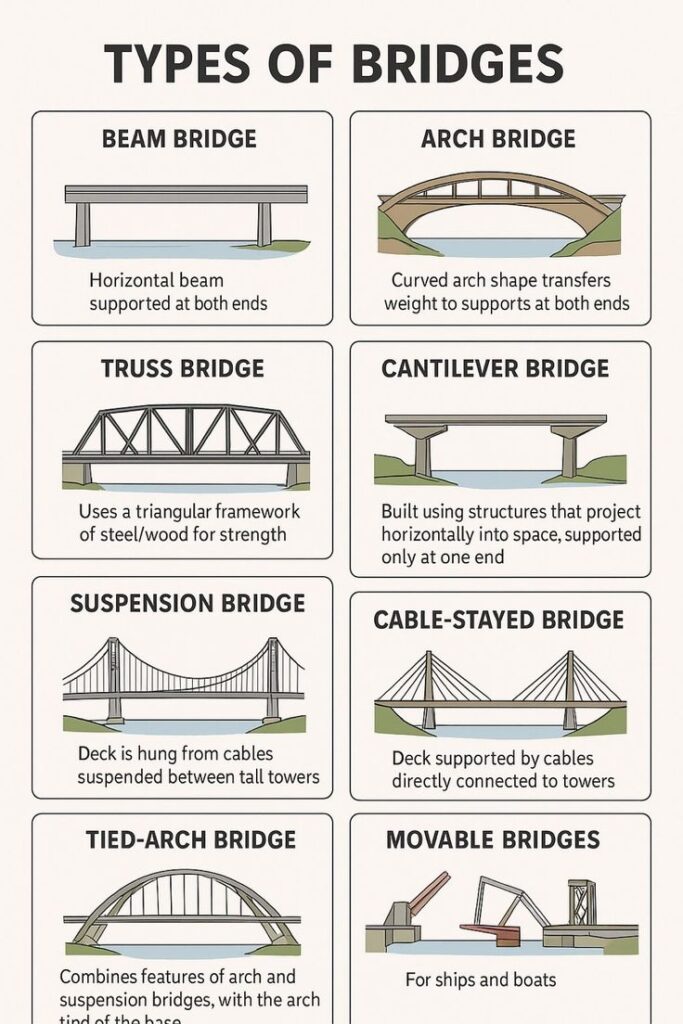
Howrah Bridge is designed as a cantilever bridge, a structure where two projecting beams extend from opposite sides and support a central suspended span.
This design offers several advantages:
1)No piers are required in the middle of the river
2)It allows uninterrupted river navigation
3)It provides high structural strength for heavy traffic loads
Cantilever bridges are commonly used where building foundations in the middle of a river is difficult.
Steel Truss Structural System
The bridge uses a steel truss system to distribute loads efficiently. A truss structure consists of interconnected steel members forming triangular patterns.
The main structural components include:
Top chord
Bottom chord
Vertical members
Diagonal bracing
These elements work together to transfer loads from vehicles and pedestrians to the main support towers.
Foundation System
The foundations of the bridge are constructed using caisson foundations.
Large caissons were sunk deep into the riverbed near the riverbanks. These caissons were then filled with concrete to create a stable base capable of supporting the massive steel structure.
This foundation technique is commonly used in large bridge construction projects across rivers.
Key Structural Features
Feature Details
Bridge Type
Cantilever Steel Bridge Total Length-Approximately 705 m
Main Span-Approximately 457 m
Width-Around 21.8 m
Steel Used-About 26,500 tons
Year Opened-1943
Importance of Howrah Bridge
The Howrah Bridge is not only an important transportation link but also a symbol of engineering excellence in India. It carries over one million pedestrians and thousands of vehicles daily, making it one of the busiest bridges in the world.
The bridge also represents a significant achievement in civil engineering, demonstrating advanced design concepts such as cantilever structures, steel truss systems, and deep foundation techniques.
Conclusion
The Howrah Bridge stands as a remarkable example of early 20th-century engineering. Its innovative design and strong steel structure have allowed it to serve millions of people for decades. Today, it remains one of the most iconic landmarks in India and continues to play a vital role in the transportation network of Kolkata.